
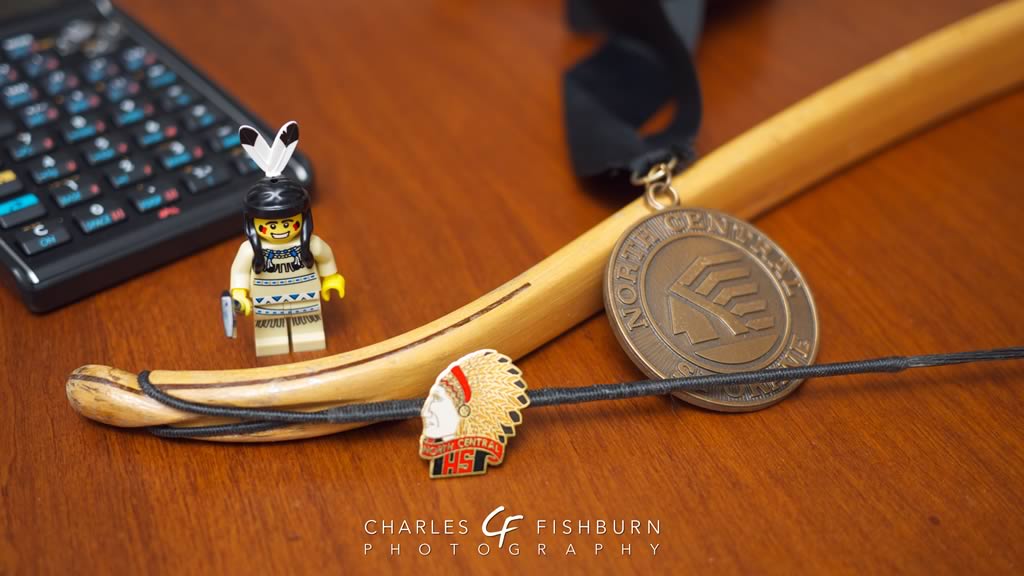
On the Issue of Indians and Mascots
A dear friend of mine is the editor for the community-specific news website, The Sammamish-Issaquah Patch. Recently, she directed me to an article on the site which posed the question, "Is the Sammamish High School mascot, the Totems, offensive?" Given my own connection to this very topic, she thought I might like to chime in and share opinion on the matter. After a bit of deliberation and quite a bit of thinking and re-thinking, I decided to do just that.
I am an American Indian, a member of the Colville Tribe, and as Jeanne Gustafson mentioned in one of her comments on the Patch's article, a former high school mascot for the North Central Indians in Spokane, Washington. While I only served as mascot for the high school for a single year in the late 80's, I thought at the time that it was an honor to serve as mascot and to wear the traditional regalia that was hand-crafted and donated by the Spokane Tribe. Would I do it again? I don't think so. It's a bit difficult to elucidate sufficiently, but I'll make an attempt.
Disclaimers from the Unarmed — That Means: "Don't Shoot!"
Before delving into this discussion, let me first say that this is solely my opinion, and not necessarily representative of the opinions of the elders or elected council members of the Colville Tribe. I am merely speaking for myself and from my own experiences. You are welcome to disagree with my conclusions, but please don't discount my perspective.
Let me also say that I do not consider myself to be a hyper-sensitive minority activist. I am not writing this to vehemently hammer my point into the heads of unsuspecting citizens. I am not writing this with the claim that my first-hand experience and cultural background trump the opinions of all dissenters. And despite how this may come across, I understand entirely how this particular issue seems more grey than red and white.
Label Me This
I am not going to use this space to debate the greater merits or lesser evils of the terms "American Indian", "Native American", "First Nations" or "Indigenous Peoples". Ultimately, those are simple labels – a means of identifying or distinguishing in a general sense the pre-Columbian population of North America and their descendants. I will not balk when someone uses one of those terms in reference to my ancestry. And quite honestly, I will not complain or cringe if someone simply uses the term "Indian", so long as I know that they know it means "American Indian" and not Indian-American (from India). Yes, I understand that many people consider "Indian" as it refers to the indigenous nations to be technically and ethnically and symbolically and <insert other adverbs here> wrong. Some even consider "American", given its basis in the name of another Italian explorer (Amerigo Vespucci), to be an affront.
I do believe that the American population, for the most part, tries to be non-offensive in this matter of labels. In an age of emphasized political correctness, however, I know that people don't necessarily know which term, if any, is more preferred and which term(s) may be considered archaic.
As relaxed as that may seem, I will admit that I don't appreciate it when a non-Native says, "Well, I was born in this country, doesn't that make me Native American?" No, that makes you a native American just as being born in Washington makes you a native Washingtonian. It does not, however, make you Native American. But it's much easier to make the distinction in writing than in speaking, and I digress.
Weren't We Talking About Mascots?
After that lengthy dissertation, let's return to the topic at hand: the acceptability – or impropriety – of American Indian-inspired mascots. What's wrong with "Indians", "Braves", "Chiefs", "Warriors", "Redskins" or "Totems"? To see the potential problems with these, it may be effective to consider a relatively simple counter-example.
How many people would be in favor of – or even just comfortable with – using a different non-caucasian/minority ethnic group for a mascot? Pick general labels first and consider the "Chinese", "Africans", "Maori" or "Jews". Then maybe consider the "Zulus", "Gypsies", "Levites", "Samurai" or "Sheikhs". How about just going with skin "color": "Blackskins", "Brownskins" or "Yellowskins"? Now how appropriate do "Indians", "Braves" and "Redskins" sound? What about the First Nations peoples separates us as exempt from this kind of exploitation?
I understand that in using the Native American as a symbol, most schools or organizations are trying, as a course of tribute, to conjure the spirit of honor and courage. I also understand, although it may sound cliché, that there is a measure of fond legacy attributed to the idea of the Native American as an indelible figure in the fabric of our country's backdrop. And we certainly should recognize that as a mascot goes, the American Indian, like many other culture- or people-based mascots such as the Vikings, Saxons, or even Crusaders, has been chosen from an historical perspective. But we shouldn't let that distance from the past equate to the validity of an implied separation between the people of yesteryear and their living descendants of today. Those people from "way back when" live and breathe across this nation through their successive generations. Yet many mascots claiming to commemorate them bring about more disdain. One look at the wide-grinning, round-nosed, red-faced logo of the Cleveland Indians and you see remnants of less culturally-sensitive and politically-correct times. That image neither represents nor honors me or anyone I know. On the contrary, it reminds me of old black and white cartoons with daft "Injuns" who were so stupid they could barely avoid tripping over their own moccasins, and it frustrates me.
Similarly, our pow wows and other celebrations are not models for athletic rally cries. Any sort of crowd pleasing, fever pitch-inducing action like the Atlanta Braves' infamous "tomahawk chop" is like no Fancy Dance I've seen in my lifetime. The quasi-ominous chords in parallel fourths that typify a Hollywood-flavored cue that "the Injuns are a-comin'" are cheap imitations of the heart-pounding songs played around the drums at a pow wow, and don't hold a candle to the sweet Honor Song my cousin's son sang at my aunt's recent funeral.
Getting to the Point
We come back to the point of honor. Don't most of these mascots truly honor my people? One truth of this matter is that these mascot modes and models are mixed, and result in a confusing message of esteem and disregard that really should be much more clear. Are the Indigenous Peoples of this continent due proper acknowledgement, respect and protection like other culture groups or are they unwitting objects for mass entertainment?
In the end, I think to an extent that if you make a fool of one, you make a fool of all. The honor is nullified by the caricature, and the caricature ends up being a slight against the group. Further, I think that worse than any direct offense by the use of the American Indian and related symbols, it is the occasional and the potential casual, comic, or simply ignorant exaggeration of the prototype that reinforces the negative attributes of outdated stereotypes. It reflects an attitude that effectively marginalizes a minority group, and in turn, necessitates the transition away from Native American mascots.